

Poland's e-Sprawozdanie is the structured XML format for annual financial statements, submitted to the KRS (National Court Register) e-Sprawozdania system. Getting the data into the correct XML is most of the work. It is not the whole process, and we are clear about where automation stops.
What a e-Sprawozdanie requires
Three distinct steps, in this order:
Correctly structured XML matching the current schema version, built from your actual ledger data rather than manually transcribed. Balance sheet, profit and loss, supporting notes — all reconciling with your books, not just looking plausible.
A qualified electronic signature (XAdES format) applied to the generated document. The signature has to be issued to a named individual with signing authority for the company.
Submission to KRS through the e-Sprawozdania portal, within the statutory deadline (15 days after shareholder approval).
Each step has to happen. None of them can be skipped.
What runs today in Vedron
Vedron generates the e-Sprawozdanie XML directly from your ledger, matching the schema Poland's filing system expects. You are not building the document by hand or reconciling it against your books after the fact. The ledger numbers that go into the statement are the same numbers in your other Polish reporting — one source, consistent output.
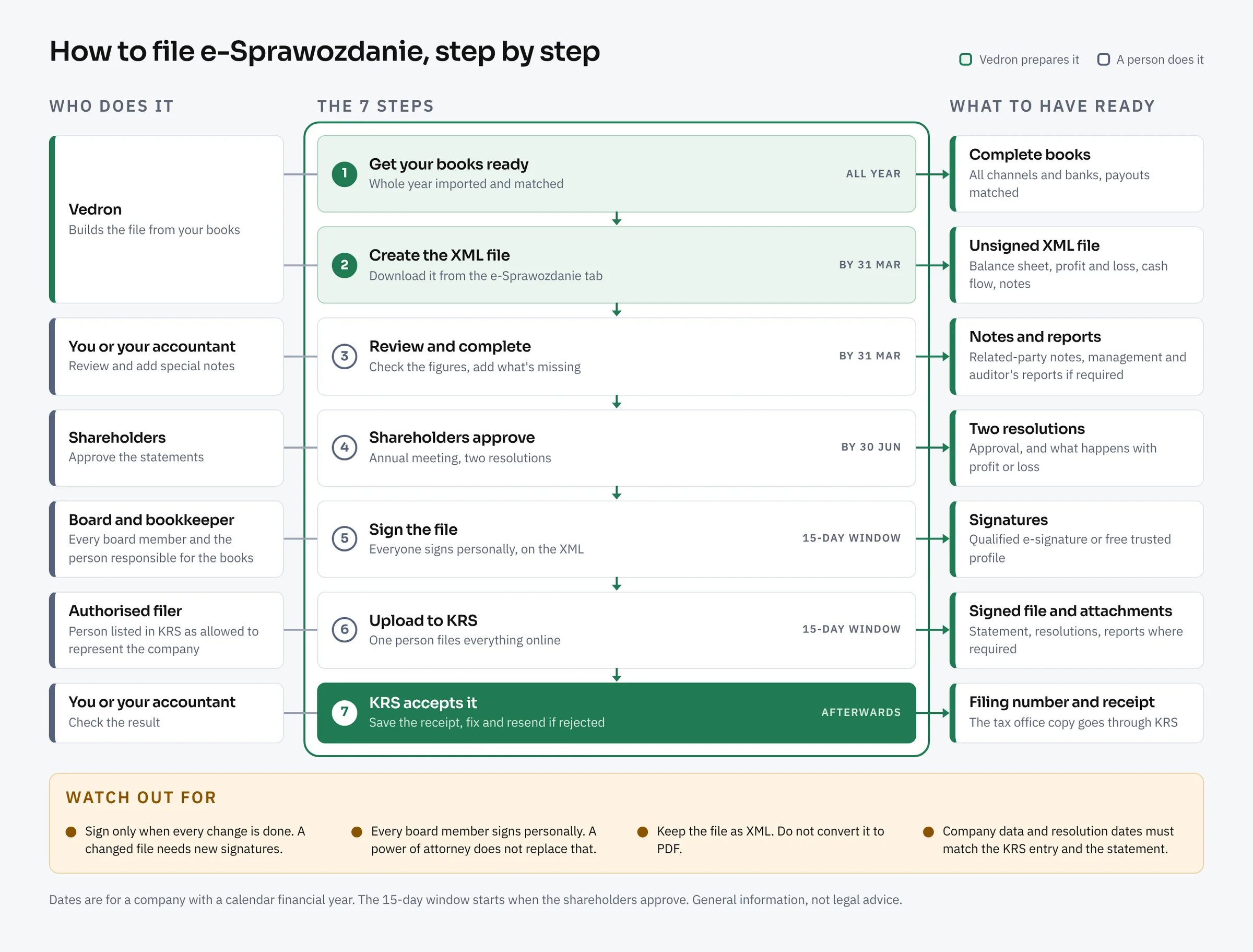
Direct about scope: the XML this produces is unsigned by design. Applying the qualified electronic signature and submitting the signed file to KRS remain manual steps today, performed by your tax advisor or signatory. That is the correct split under current Polish rules: the preparation is automated, the attestation is human.
Why the split (preparation vs. attestation) is correct
An annual financial statement is a legal declaration of your company's financial position. The person signing it is attesting that the numbers are correct and that the statements comply with Polish accounting law. That attestation has to be a conscious act by a named individual, not something that happens automatically in software.
What Vedron automates is the part that is purely mechanical: translating your ledger into the XML schema the regulator expects. What it leaves to the human: the review, the attestation, the submission. The division matches how your accountant already works.
The filing timeline, in plain terms
For a Polish company with a calendar fiscal year (January to December):
By March 31: financial statements must be prepared.
By June 30: shareholders approve the statements at the AGM.
Within 15 days of approval: file with KRS via e-Sprawozdania.
Within 10 days of approval: file with the tax office (handled automatically when you file with KRS).
Most small companies compress this. The accountant prepares and the shareholders approve in a single session in April or May, with KRS filing in the following week.
What Vedron does not do:
Three things remain outside the current scope:
Signing the file. You or your accountant apply the qualified signature using a certified signature tool.
Submitting to KRS. You upload the signed file through the e-Sprawozdania portal.
Complex notes and disclosures. For most standard templates the notes section is auto-generated; for companies with specific disclosures (related-party transactions, significant estimates, unusual events), the notes section becomes a review-and-add step.
What we do: hand you a correctly structured XML file that reconciles with your books, so steps 2 and 3 above become mechanical rather than reconstruction projects.
Frequently asked questions
Does this submit my filing to KRS automatically?
No. It generates the correctly structured XML from your ledger data; the qualified electronic signature and the submission to KRS remain manual steps. This is deliberate — Polish law requires a human signatory to attest to the statement — and matches how your tax advisor expects to work.
What schema version does this target?
The current e-Sprawozdania XML schema published by the Ministry of Finance. Schema versions update periodically; confirm your build matches the current filing year's requirements before submission. Vedron updates the schema when the Ministry publishes a new version, usually within days of release.
Does this work for Polish companies on UOR?
Yes. The generator is built against the same UOR-based ledger structure Vedron uses for Polish companies. The statement reconciles with the same books your regular Polish reporting already uses.
Who in my organisation signs the file?
The person with signing authority for the company — typically the board member or director named in the KRS registration. In practice, most small companies have their accountant prepare and sign on the company's behalf under a power of attorney. The qualified electronic signature (QES / XAdES) has to be issued to a named individual.
What is the filing deadline?
Annual financial statements under Polish law must be approved by shareholders by June 30 following the fiscal year, filed with KRS within 15 days of approval, and submitted to the tax office (via KRS) within 10 days of approval. Vedron produces the file; you file within the window.
What happens if KRS rejects the submission?
The submission is returned with an error. Common causes: wrong schema version, missing attachments (independent auditor's report where required), mismatched tax-ID. The file needs to be corrected and resubmitted. Vedron validates against the schema before you receive the file, so schema errors should not occur, but attachment and metadata issues can.
Do I need an auditor's report attached?
Required for companies above certain size thresholds under Polish accounting law. For companies below those thresholds, the statement is filed without an audit report. Your accountant tells you which applies.
Does this generate the full set — balance sheet, P&L, cash flow, notes?
Vedron generates the balance sheet and P&L directly from your UOR ledger. The cash flow statement and detailed notes are generated for most standard templates; for complex companies with specific disclosures, the notes section is a manual review step where you or your accountant add explanatory text.
Talk to us about your setup
Every seller's mix of marketplaces, currencies and payment methods is a little different. Book a short call and we will walk through yours on your real data. Beta clients get the first two months of custom setup on us, and the standard trial can be extended on request.