
Menu

Shop

Region & Language

BlogVedron

A new bike or sporting goods retailer usually reaches for one of two tools first: a CMS to get a storefront live, or an ERP to handle stock and orders properly from the start. Picking one and adding the other "later" is common -- and it's also the point where a lot of avoidable rework gets created.

Why this vertical specifically feels the gap

Bikes and sporting goods have real inventory complexity that a lot of other retail categories don't: size and color variants that matter for fit (frame size, not just style), components that get bundled or swapped, and seasonal demand swings that make stock accuracy genuinely consequential rather than a nice-to-have. A CMS-first setup tends to handle the storefront and content well but treats stock as a number to display, not a number to actively manage across suppliers and channels. An ERP-first setup handles stock and accounting well but often leaves the storefront as an afterthought, built later on top of data structures that weren't designed with a public-facing site in mind.

What actually goes wrong when they're bolted together later

The product catalog usually gets built twice -- once in the CMS for display, once in the ERP for stock and pricing -- with no single source of truth, so someone has to manually keep both in sync every time a product changes. Orders placed on the storefront don't automatically become stock-accurate ERP records, so fulfillment and accounting run a step behind sales. And promotions or size-variant changes made in one system don't propagate to the other without someone remembering to do it twice.

What "both on day one" actually looks like

One product record that both the storefront and the stock/order system read from, so a size-variant or price change happens once. One stock number that both a storefront sale and a marketplace sale (Amazon, Allegro, eBay, wherever else you sell) decrement, so nothing needs manual reconciling. One order pipeline that flows straight into fulfillment and accounting, rather than a storefront order that has to be re-entered into the "real" system.

How Vedron handles this

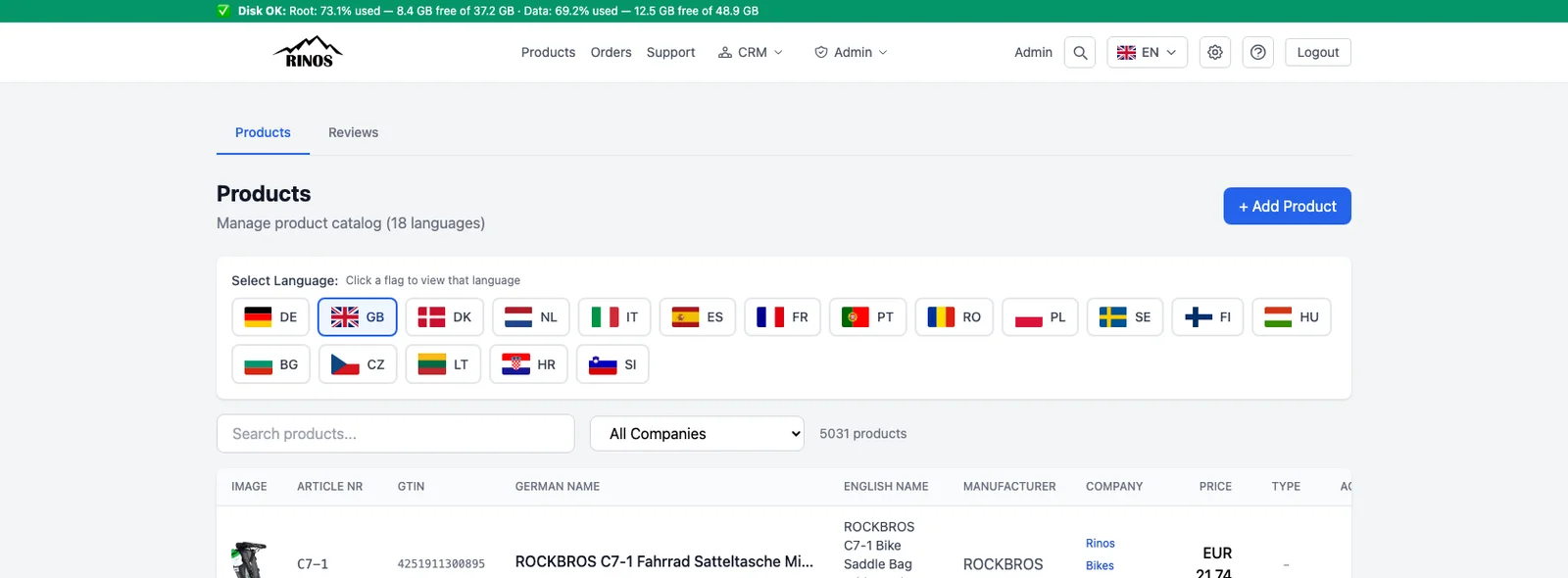
Vedron's CMS and ERP share the same underlying product, stock, and order data rather than being two separate products with an integration layer bolted between them afterward. A bike frame's size variants, stock level, and price live in one place and are read by the storefront, the marketplace connectors, and the accounting/invoicing side alike -- so there's no "which system is the real one" question to answer later, and no catalog to eventually reconcile because it was never duplicated in the first place.

Frequently asked questions

Can I start with just the CMS or just the ERP and add the other later?

Yes, but the point of this post is that starting with both from day one avoids the catalog-duplication and reconciliation work that comes from adding the second one afterward -- it's a sequencing recommendation, not a hard requirement.

Does this handle component bundles (e.g. a bike sold with accessories)?

Bundle/component relationships are modeled at the product-data level, so stock for a bundled item reflects the actual component availability rather than being tracked as an independent, disconnected SKU.

What about seasonal demand swings specific to bikes and sporting goods?

Accurate real-time stock across every channel is what makes seasonal demand manageable in the first place -- the harder problem it solves isn't forecasting demand, it's making sure you're not overselling stock you don't actually have when demand spikes.

Have a question specific to your setup?

Every seller's marketplace mix and stock setup is a little different -- if you're weighing this against your own, book a short call and we'll walk through it with you directly rather than leaving you to figure it out from a blog post alone.

Beta offer: if you join as a beta client, custom integration setup -- configured for your actual marketplace and inventory mix -- is free for your first 2 months.

Still evaluating and need more time than the standard trial window? Just ask us for an extension -- we're happy to give you the room to actually test it properly before deciding.

Book a call or see plans and get started.

All posts

CMS or ERP First? Why Bike & Sporting Goods Sellers Need Both on Day One

24. Februar 20264 min read

A new bike or sporting goods retailer usually reaches for one of two tools first: a CMS to get a storefront live, or an ERP to handle stock and orders properly from the start. Picking one and adding the other "later" is common -- and it's also the point where a lot of avoidable rework gets created.

Why this vertical specifically feels the gap

Bikes and sporting goods have real inventory complexity that a lot of other retail categories don't: size and color variants that matter for fit (frame size, not just style), components that get bundled or swapped, and seasonal demand swings that make stock accuracy genuinely consequential rather than a nice-to-have. A CMS-first setup tends to handle the storefront and content well but treats stock as a number to display, not a number to actively manage across suppliers and channels. An ERP-first setup handles stock and accounting well but often leaves the storefront as an afterthought, built later on top of data structures that weren't designed with a public-facing site in mind.

What actually goes wrong when they're bolted together later

The product catalog usually gets built twice -- once in the CMS for display, once in the ERP for stock and pricing -- with no single source of truth, so someone has to manually keep both in sync every time a product changes. Orders placed on the storefront don't automatically become stock-accurate ERP records, so fulfillment and accounting run a step behind sales. And promotions or size-variant changes made in one system don't propagate to the other without someone remembering to do it twice.

What "both on day one" actually looks like

One product record that both the storefront and the stock/order system read from, so a size-variant or price change happens once. One stock number that both a storefront sale and a marketplace sale (Amazon, Allegro, eBay, wherever else you sell) decrement, so nothing needs manual reconciling. One order pipeline that flows straight into fulfillment and accounting, rather than a storefront order that has to be re-entered into the "real" system.

How Vedron handles this

Vedron's CMS and ERP share the same underlying product, stock, and order data rather than being two separate products with an integration layer bolted between them afterward. A bike frame's size variants, stock level, and price live in one place and are read by the storefront, the marketplace connectors, and the accounting/invoicing side alike -- so there's no "which system is the real one" question to answer later, and no catalog to eventually reconcile because it was never duplicated in the first place.

Frequently asked questions

Can I start with just the CMS or just the ERP and add the other later?

Yes, but the point of this post is that starting with both from day one avoids the catalog-duplication and reconciliation work that comes from adding the second one afterward -- it's a sequencing recommendation, not a hard requirement.

Does this handle component bundles (e.g. a bike sold with accessories)?

Bundle/component relationships are modeled at the product-data level, so stock for a bundled item reflects the actual component availability rather than being tracked as an independent, disconnected SKU.

What about seasonal demand swings specific to bikes and sporting goods?

Accurate real-time stock across every channel is what makes seasonal demand manageable in the first place -- the harder problem it solves isn't forecasting demand, it's making sure you're not overselling stock you don't actually have when demand spikes.

Have a question specific to your setup?

Every seller's marketplace mix and stock setup is a little different -- if you're weighing this against your own, book a short call and we'll walk through it with you directly rather than leaving you to figure it out from a blog post alone.

Beta offer: if you join as a beta client, custom integration setup -- configured for your actual marketplace and inventory mix -- is free for your first 2 months.

Still evaluating and need more time than the standard trial window? Just ask us for an extension -- we're happy to give you the room to actually test it properly before deciding.

Book a call or see plans and get started.

Did you enjoy this article?